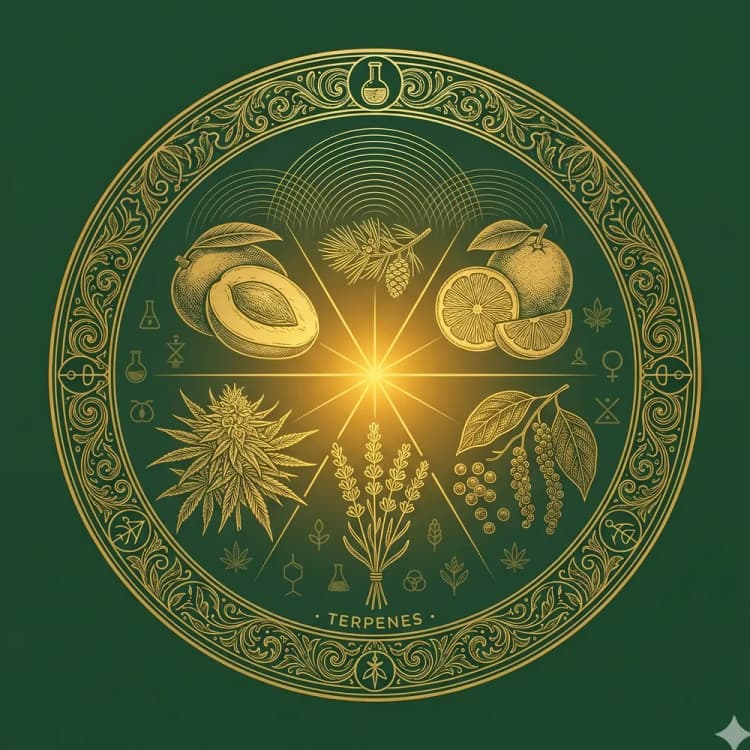
If THC is the lead singer, terpenes are the production — the room the music is recorded in. They're why two flowers with identical THC percentages can feel like two different drugs, and they're the most under-read line on every Michigan lab report.
The dose problem (read this first)
Here is the uncomfortable truth at the center of terpene science: most terpene mechanism studies use concentrations far higher than what's present in cannabis. A typical high-terpene flower is maybe 2–3% total terpenes, and any single one is a fraction of that. So read every mechanism below as "this is the pharmacology the molecule is capable of" — not "this is definitely happening in your bloodstream." Terpenes plausibly contribute, most likely through the entourage interactions of Pillar II, rather than by acting as standalone drugs. The folk taxonomy ("myrcene = couch lock") describes a real correlation in people's experience; the mechanism is subtler than the slogan. Michigan lab panels report around 40 terpene analytes, but only a handful appear at levels high enough to matter.
Myrcene — the one everyone names
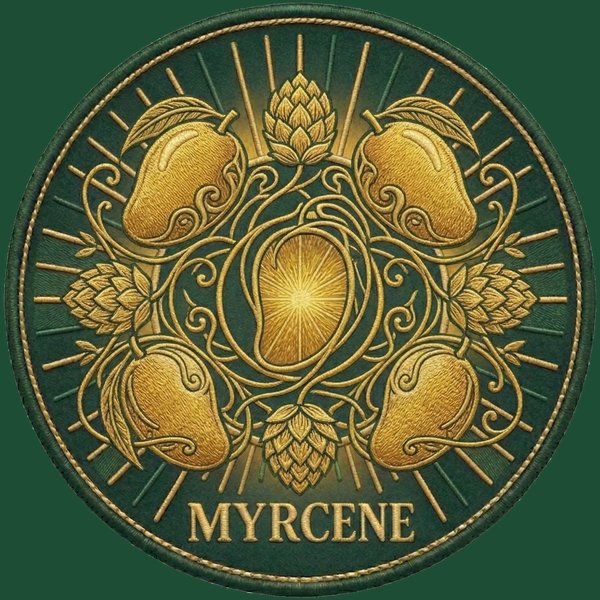
Earthy, musky, herbal, a little like cloves and ripe mango. Myrcene's sedation reputation traces to GABA — your brain's primary 'slow down' signal, which works through the GABA-A receptor (the same receptor alcohol and benzodiazepines act on). Myrcene appears to be a positive allosteric modulator: it doesn't bind where GABA binds, it binds elsewhere and changes the receptor's shape so that when GABA shows up, it works better. This is exactly why the effect is concentration-dependent. At low concentrations, myrcene occupies few sites — the boost is lost in the noise. At high concentrations it saturates those sites, every pulse of GABA lands harder, and arousal drops across the board. That non-linear, threshold-like curve is the signature of allosteric modulation. The GABA-A mechanism is real in the lab; whether inhaled cannabis delivers enough myrcene to cross that threshold in your brain is genuinely unproven.
Limonene — the bright one
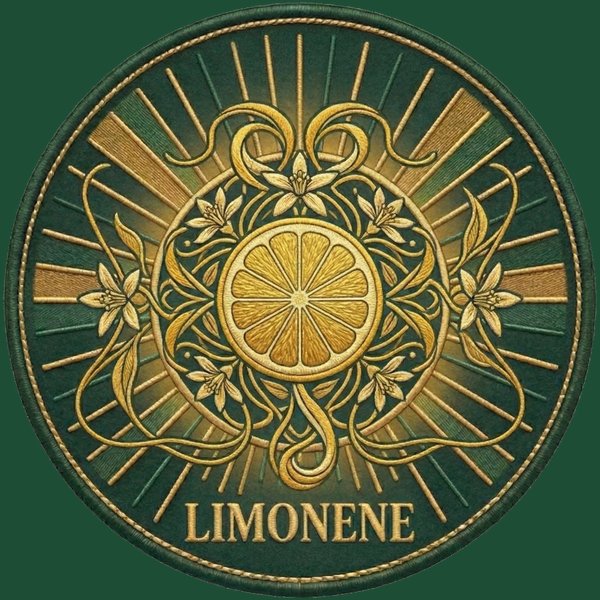
Citrus peel, lemon, orange. Limonene's uplifting, anti-anxiety reputation centers on serotonin and dopamine — possibly via 5-HT1A receptors, the same family CBD touches, which is part of why limonene-heavy, CBD-containing products read as 'settling but clear.' There's reasonably encouraging human work on limonene specifically blunting cannabis-induced anxiety — one of the better-supported terpene findings, because it was actually tested with cannabis in people.
Caryophyllene — the one that breaks the rules
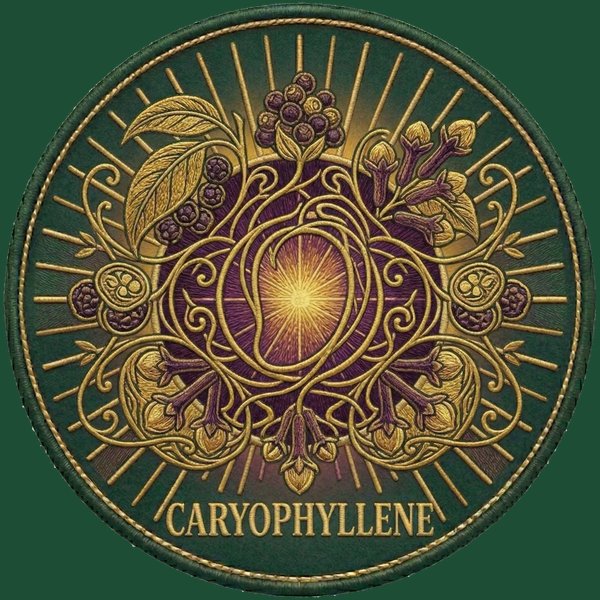
Black pepper, warm spice, a little woody. This is the most scientifically interesting terpene in cannabis: it's a terpene that is also, functionally, a cannabinoid. Caryophyllene directly activates the CB2 receptor — the immune-and-inflammation receptor — without touching CB1. It engages the anti-inflammatory arm of the endocannabinoid system with zero intoxication. The CB2 agonism is well-established and replicated, the standout among terpenes; the clinical benefit at cannabis-realistic doses is promising but still maturing.
Linalool — the lavender one
Floral, lavender, a touch of spice — it is the dominant terpene in lavender. Like myrcene it appears to modulate GABA-A toward calm, and it also seems to dampen glutamate, the brain's main 'speed up' signal — potentially working both levers. The mechanisms are real in animal models; the leap from lavender aromatherapy to the linalool fraction in your cannabis is one the evidence hasn't fully made.
Pinene — the sharp one
Pine forest, fresh, like a crushed needle. Pinene's signature claim is the most charming in cannabis: that it counteracts THC's short-term memory disruption. The proposed mechanism is that pinene inhibits acetylcholinesterase, the enzyme that breaks down acetylcholine — a neurotransmitter central to memory — so the memory fog THC induces (partly by suppressing acetylcholine) is partially offset. Lovely mechanism, real in the lab, thin human data at inhaled doses.
Humulene, terpinolene, ocimene, and the trace tier
Humulene (hoppy, earthy; travels with caryophyllene) is studied for anti-inflammatory and appetite-suppressing effects — a contrast to the munchies. Terpinolene (complex floral-pine-apple) is the "energizing sativa" marker whose own lab profile actually leans sedative — a perfect illustration that association isn't mechanism; the "energizing" feeling is the full chemovar, not the terpene alone. Ocimene is mostly about the plant's own defenses. And the Michigan panel reports many real-but-trace terpenes — nerolidol, bisabolol, guaiol, eucalyptol, camphene, geraniol and others — almost always present in amounts too small to act alone. Their honest role is the aromatic fingerprint and the collective entourage.
Why "indica vs. sativa" is the wrong question
The indica/sativa distinction is botanical — it describes the plant's growth structure, not its chemistry or effect. Decades of hybridization have made the labels nearly meaningless as effect predictors. What actually predicts the experience is the chemovar: the full profile of cannabinoids and terpenes together. The single most useful skill this pillar is trying to build is to read the terpene profile, not the strain name.
What this means for you
- ✦Total terpene content is a quality signal. Flower above roughly 2% generally indicates careful growing and curing. A 24% THC flower with 2.4% terpenes is often a better experience than a 28% THC flower with 0.8%.
- ✦Match the dominant terpene to what you're after — gently. Caryophyllene for body and inflammation (firmest mechanism), limonene for brightness and less anxiety, high myrcene for the classic heavy evening, pinene if you worry about memory fog.
- ✦Trust your nose as a real instrument. You're literally smelling the terpene profile; faint smell often means degraded or poorly cured product.
- ✦Resist any one-word terpene-to-effect promise. "Myrcene equals sleep" is a slogan. The truth is longer, less satisfying, and correct — and that difference is the difference between marketing and understanding.


















 Talk to Photi