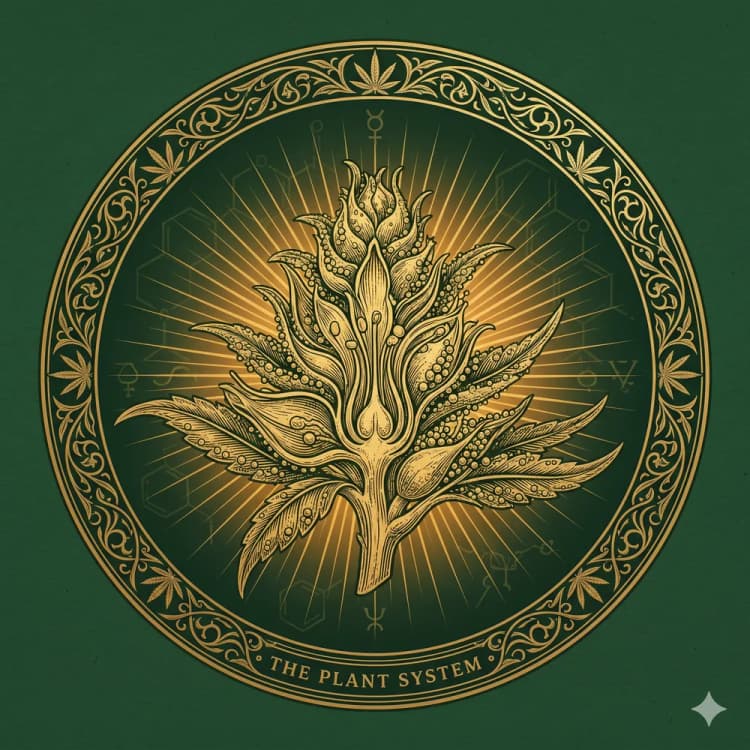
THC and CBD are just the two loudest voices in a much larger choir. Cannabis makes over a hundred cannabinoids, and a single flower can carry a dozen of them in meaningful amounts, alongside dozens of terpenes. This pillar is about the rest of the choir — and the genuinely fascinating question of what happens when they sing together.
CBD — the modulator
Recall the model from Pillar I: CBD doesn't turn the CB1 lock. It slows the breakdown of your own anandamide, interacts with serotonin receptors tied to mood, and nudges the shape of CB1 so THC lands with less intensity. CBD is the proof of concept for everything that follows — it shows that a cannabinoid doesn't have to be psychoactive to matter.
CBG — the parent molecule
CBG is the source. Early in the plant's life it produces CBGA, then enzymes convert that raw material into the acids that become THC, CBD, and CBC. CBG is the stem cell of cannabinoids — by harvest, most of it has been spent making everything else, which is why mature flower usually contains very little, and why CBG-rich products cost more. Non-intoxicating, with a clear-headed focus reputation. The lab and animal work is interesting; the large human trials largely don't exist yet.
CBN — the molecule of age
CBN is what THC slowly becomes. Leave THC exposed to oxygen, light, and time and it degrades into CBN — which is why old flower loses its punch. The popular story is that CBN is "the sleepy cannabinoid," and you'll see it in every nighttime gummy. But the honest mechanism: the evidence that CBN itself is strongly sedating is surprisingly thin. The drowsiness of aged cannabis is now thought to come substantially from sedating terpenes that concentrate as flower ages, not from CBN alone. A working "CBN sleep" product is usually doing its job through the full formulation, not CBN as a magic switch.
CBC — the quiet one
CBC barely binds CB1 or CB2 at all. Instead it activates TRP receptors involved in pain and inflammation — the same channels that respond to a chili pepper's heat — and slows anandamide breakdown like CBD. Anti-inflammatory and mood research is early, but its presence in a whole-plant product is a real ingredient doing real signaling, even if no one prints it on the package.
THCV — the contrarian
THCV behaves almost paradoxically by dose. At low doses it acts as a CB1 blocker — the mechanism behind its "diet weed" reputation for suppressing appetite and feeling clear and energetic. At higher doses the picture flips and it activates CB1 more like THC. It concentrates in certain landrace-derived African sativa lineages, which is why genuinely THCV-rich products are uncommon and sought after.
The entourage effect: mechanism, not marketing
The phrase gets eye-rolls, and some of that is earned. So let's defend it on the only ground that matters — the actual mechanism. The entourage effect is the observation that cannabis compounds taken together produce effects that differ from any one taken alone. There are concrete, non-mystical reasons this happens:
- ✦One molecule changes how another lands. CBD reshapes the CB1 receptor so THC binds with less intensity. A 10mg THC product with meaningful CBD is genuinely a different experience than 10mg THC alone.
- ✦Compounds share the same exits. CBD, CBC, and others all slow the breakdown of anandamide; pile several together and you protect your own endocannabinoids more than any single one would.
- ✦Terpenes are full participants, not garnish. They influence how cannabinoids cross into the bloodstream and interact with their own mood and inflammation pathways.
- ✦Different targets, combined results. When THC hits CB1, CBC nudges pain channels, CBD works serotonin receptors, and terpenes touch their own pathways, the sum is a profile no single compound could produce.
The intellectual honesty this demands: the entourage effect is well-supported as a mechanism and still under-quantified as a clinical claim. That CBD blunts THC is solid. The much stronger claims on packaging — that a precise terpene blend reliably produces a specific named mood in a specific person — outrun the evidence. Believe the chemistry. Stay skeptical of the slogan. Both at once.
Why whole plant behaves differently than an isolate
An isolate is a single cannabinoid stripped to purity. A distillate is close — highly refined, mostly one or two cannabinoids. A full-spectrum product preserves the original ensemble. An isolate is a clean, single instrument: predictable and controllable, which is why it dominates edibles and vapes where consistent dosing matters. Whole plant is the full ensemble: the well-documented example is that pure THC tends to produce more anxiety than the same THC accompanied by CBD and a full terpene profile — the supporting cast takes the edges off. Neither is the "real" cannabis. They're two legitimate answers to the question of what you want the experience to be: precision versus completeness.
What this means for you
- ✦The THC percentage is the least complete thing you can know. It tells you how loud the lead singer is and nothing about the rest of the band.
- ✦The cannabinoid that fixes your issue may not be THC. CBG for clear focus, CBN-in-context for sleep, THCV for energetic and appetite-light, CBD for settling without intoxication.
- ✦When two products share a THC percentage but feel completely different, the answer is in everything the label didn't shout: the minor cannabinoids, the terpenes, the ratios.
- ✦Hold the entourage pitch correctly: the mechanism is real, the cooperation is genuine, and the specific promises sometimes outrun the proof.
 Talk to Photi