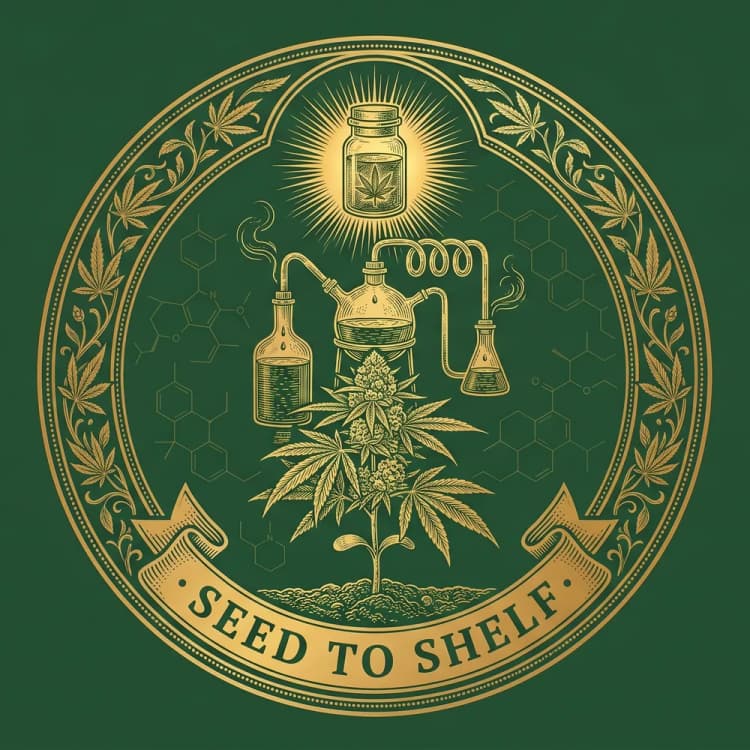
Every jar on a dispensary shelf has a backstory — months of growing, a harvest, a cure, often an extraction, and a battery of lab tests — and understanding that journey is the supply-side complement to everything in the science reference. It's also the most practical thing you can learn for reading a label, because the words on the package ('live resin,' 'distillate,' 'rosin') are really just names for points along this path. Once you know the journey, the label stops being jargon and starts being information.
Growing — where the chemistry is decided
Everything in Pillars II and III — the cannabinoid mix, the terpene profile — is largely determined here, in how and where the plant is grown. The cannabis plant spends a vegetative phase growing leaves and structure, then a flowering phase where the resinous buds (and their cannabinoids and terpenes) actually develop. Growers manipulate light cycles to trigger flowering, and the conditions during this stretch shape the final chemistry.
There are three broad growing environments, and each leaves a fingerprint:
- ✦Indoor — fully controlled light, temperature, and humidity. The most expensive to run and typically the most consistent and potent, with carefully preserved terpene profiles. Most premium flower is indoor.
- ✦Greenhouse — a middle path using natural sunlight with some environmental control. Lower cost, often good quality, more seasonal variation.
- ✦Outdoor — sun-grown in the field. The cheapest and most sustainable, with the plant exposed to real weather; quality varies more, and it's often destined for extraction rather than top-shelf flower.
None of these is inherently "better" — but indoor's control is why it dominates the premium end, and outdoor's economics are why it often feeds the extract supply. The total-terpene quality signal from Pillar III tends to correlate with careful growing, whatever the setting.
Harvest, dry, and cure — the step that's easy to ruin
Timing the harvest matters: harvest too early or too late and the cannabinoid and terpene balance shifts (recall from Pillar II that aging THC degrades toward CBN). After cutting, the flower is dried slowly, then cured — stored in controlled conditions for weeks, which lets harsh compounds break down and preserves the volatile terpenes that carry aroma and flavor. A good cure is a big part of why some flower smells vivid and tastes smooth while other flower is harsh and faint. It's unglamorous and invisible on the label, but it's where a lot of quality is won or lost.
Extraction — turning flower into everything else
Most products that aren't raw flower — vape carts, edibles, tinctures, concentrates — start with extraction: pulling the cannabinoids and terpenes out of the plant material into a concentrated form. The method shapes the product, and the names you see on shelves are mostly extraction labels. Here's the honest map, from gentlest to most processed:
Solventless (rosin). The cleanest concept: use only heat and pressure to squeeze the resin out — no chemicals involved. "Rosin" and "live rosin" are the premium solventless products, prized for capturing the full plant profile (the whole-plant ensemble of Pillar II) without solvent residue. Generally the most expensive and most sought-after by purists.
Hydrocarbon (BHO, live resin). Uses butane or propane as a solvent to strip the resin, then purges the solvent off. Done properly in a licensed, tested facility, the solvent is removed to trace levels. "Live resin" means the starting material was flash-frozen fresh rather than dried first, which preserves a fuller, more vivid terpene profile — which is why live resin carts and concentrates taste so much more like the living plant. This is the workhorse of high-quality vape and dab products.
CO2 extraction. Uses pressurized carbon dioxide as the solvent — clean and tunable, common for vape oil. Can be gentle on the plant, though some terpenes are often lost and sometimes reintroduced afterward.
Distillate. The most processed end of the spectrum: extract that's been refined down to near-pure cannabinoid — often 90%+ THC — with most terpenes and minor cannabinoids stripped away. This is the isolate-versus-whole-plant distinction from Pillar II made physical. Distillate is potent, odorless, consistent, and cheap to dose precisely, which is why it dominates mass-market edibles and budget carts. Some makers add terpenes back afterward to recreate a profile or flavor. It's not 'bad' — it's a clean single instrument — but it's the opposite of full-spectrum.
The label decoded
Solventless / rosin / live rosin = no chemical solvent, full profile, premium. Live resin = solvent-extracted from fresh-frozen plant, vivid terpenes, high quality. Distillate = highly refined, near-pure cannabinoid, terpenes stripped (sometimes added back), potent and consistent. "Full-spectrum" points back toward the whole-plant ensemble; "distillate" points toward the clean isolate. Same trade-off as Pillar II: completeness versus precision.
Testing — why the COA exists
Before anything reaches a Michigan shelf, it goes through a licensed safety-compliance lab, which produces a Certificate of Analysis — the COA. This is the document behind the legal market's whole promise, and it's why the vitamin-E-acetate vape crisis from Pillar IV was an illicit-market problem, not a tested-product one. A Michigan COA checks for far more than potency: it confirms the cannabinoid numbers, screens for pesticides, residual solvents (critical for hydrocarbon extracts), heavy metals, microbial contamination, mold and mycotoxins, and foreign matter. Terpene profiling is also available and reported on many COAs — typically a panel of around 40 terpenes, the data source behind everything in Pillar III.
The practical upshot: the COA is the difference between knowing and guessing. A tested product tells you what's actually in it and what isn't; an untested one asks you to trust a stranger. Many products carry a QR code linking to the COA — and learning to glance at it is one of the highest-value habits a consumer can build.
How to read a label, end to end
Put the whole journey together and a label becomes legible. Here's what to actually look at, roughly in order of usefulness — and note how little of it is the big THC number that the packaging shouts:
- ✦The cannabinoid profile, not just total THC. Look for the full breakdown — THC, CBD, and any minor cannabinoids — and the ratio between them (Pillar II). A 1:1 THC:CBD product is a genuinely different experience than a THC-only one at the same THC number.
- ✦Total terpene content and the dominant terpenes (Pillar III). Above ~2% total is a quality signal; the dominant terpenes tell you more about how it'll feel than the strain name does.
- ✦The product type / extraction — flower, live resin, rosin, distillate — which tells you where on the whole-plant-to-isolate spectrum it sits, and therefore what kind of experience to expect.
- ✦The method and its onset implications (Pillar IV) — especially for edibles and beverages, where "nano" and dosing matter enormously, and where the per-piece milligram dose is the number to respect.
- ✦The COA / test info — that it was tested at all, and ideally a glance at the actual certificate via the QR code.
- ✦The strain name — last and least. It's marketing, and as Pillar III explained, indica/sativa labels are nearly meaningless as effect predictors. Read the chemovar, not the name.
What this means for you
- ✦Where the chemistry is set: the grow decides the profile, and the cure preserves (or wastes) it — invisible on the label but central to quality.
- ✦The extraction names are a spectrum: solventless/rosin and live resin sit near the full-plant end; distillate sits at the pure-isolate end. Completeness versus precision, exactly like Pillar II.
- ✦The COA is the legal market's whole promise — potency plus a full safety screen — and glancing at it is the highest-value habit you can build.
- ✦Read a label in this order: cannabinoid ratio, terpenes, extraction type, method/dose, test info — and the strain name dead last.

 Talk to Photi