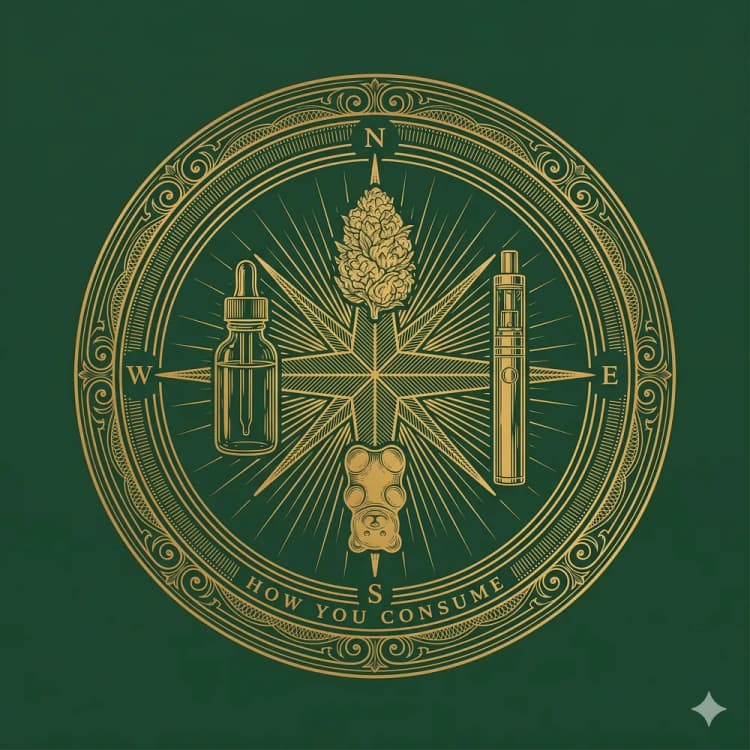
Here's the fact that catches more people off guard than any other: "10mg" is not a dose. It's a quantity. What actually reaches your bloodstream — how fast, in what chemical form, for how long — depends entirely on the door you sent it through. Ten milligrams smoked and ten milligrams eaten are, pharmacologically, almost different drugs.
Two roads into the blood: the lungs and the liver
Through the lungs (inhalation): THC vaporizes, crosses the thin, blood-rich surface of your lungs directly into the bloodstream, and goes almost immediately to the heart and then straight to the brain. One of the fastest delivery routes the body has. Through the gut and liver (ingestion): cannabis travels to your stomach and intestines, and every drop of that blood drains first into the liver before reaching the rest of you. That mandatory liver stop — first-pass metabolism — is the hinge the whole pillar turns on.
First-pass metabolism and 11-hydroxy-THC
When inhaled THC reaches the brain, it's still THC. When eaten THC hits the liver on its first pass, liver enzymes convert a large fraction into a new compound — 11-hydroxy-THC. And this is not a weaker leftover: it's a more potent psychoactive molecule, crossing into the brain readily and producing effects often described as stronger, more bodily, more psychedelic, and longer-lasting. Same 10mg, two completely different molecules arriving at your CB1 receptors. That's the deepest reason the experiences diverge — not just speed, but the actual identity of the drug doing the work.
Smoking — fast, sharp, short
Onset in seconds to a few minutes; peak around 10 minutes; tapering over 1–3 hours. Primarily THC, with variable bioavailability. The shape that matters: a sharp peak and a fast fall make smoking, counterintuitively, the most controllable method — the feedback loop is nearly instant, so you can simply stop. You essentially cannot accidentally overshoot the way you can with an edible. The fast onset is the safety feature. The cost is combustion: tar and the destruction of some cannabinoids and terpenes.
Vaping — same curve, cleaner delivery
Essentially the same timing as smoking, but without combustion — no smoke, far less tar, and better preservation of heat-sensitive terpenes. Often a bit more efficient. But "vape" is two different products: dry-herb and live-resin vaporizers deliver the plant's actual chemistry, while distillate cartridges are often near-pure THC stripped of the entourage. One safety note: the 2019 lung-injury outbreak was traced overwhelmingly to illicit-market carts cut with vitamin E acetate, not regulated, lab-tested products — which is exactly why testing exists. Buy tested.
Eating — slow, deep, long, dangerous if rushed
Onset 30 minutes to 2 hours; peak 2–4 hours; lasting 4–8+ hours. Heavily 11-hydroxy-THC, with low and highly variable bioavailability. The feedback loop that makes smoking safe is broken: you eat 10mg, feel nothing for over an hour, and the intuitive response — 'it's not working' — leads to the single most common cannabis mistake, eating more. Then both doses arrive together as potent 11-hydroxy-THC, climbing for hours with no off-switch. The rule follows directly: start at 2.5–5mg and wait a full two hours before even considering more. The curve literally doesn't finish telling you the truth for two hours, and the molecule waiting at the end is stronger. Eating compounds two unknowns from Pillar I — your ECS baseline and your individual rate of liver metabolism.
Drinking — and the nano-emulsification revolution
THC hates water — it's oil-soluble. A naive cannabis drink is just an edible in liquid form, with the same slow, unpredictable onset. The solution is nano-emulsification: shattering the THC oil into nanoscopic droplets, each wrapped in an emulsifier so it suspends in water. This multiplies surface area enormously (faster, more complete absorption) and lets a meaningful fraction begin absorbing high in the digestive tract, partially bypassing the full first-pass liver transformation. The result is a completely different curve: onset in 10–20 minutes and shorter duration, engineered to mimic the rhythm of an alcoholic drink. It restores the fast feedback loop that makes a substance controllable. The honest caveat: "nano" gets slapped on labels loosely, and emulsification quality varies. A well-engineered one behaves like the fast curve; a poor one behaves like a slow edible.
What this means for you
- ✦Match the method to the occasion. Want controllable and social with a clear off-ramp — inhalation or a well-made nano beverage. Want a long, deep, bodily evening — that's the edible's genuine strength, if you respect its onset.
- ✦The two-hour edible rule is non-negotiable — the curve hasn't finished reporting for two hours, and 11-hydroxy-THC is stronger than what you'd get any other way.
- ✦Inhaled tolerance does not equal edible tolerance. It's a different molecule by a different road; veteran smokers flatten themselves on edibles constantly. Start low with edibles regardless of smoking history.
- ✦Read "nano" with informed skepticism — judge by stated onset time and the brand's seriousness, not the buzzword.

 Talk to Photi